
Franchise Supermarket vs Independent Supermarket: Which One Should You Choose?
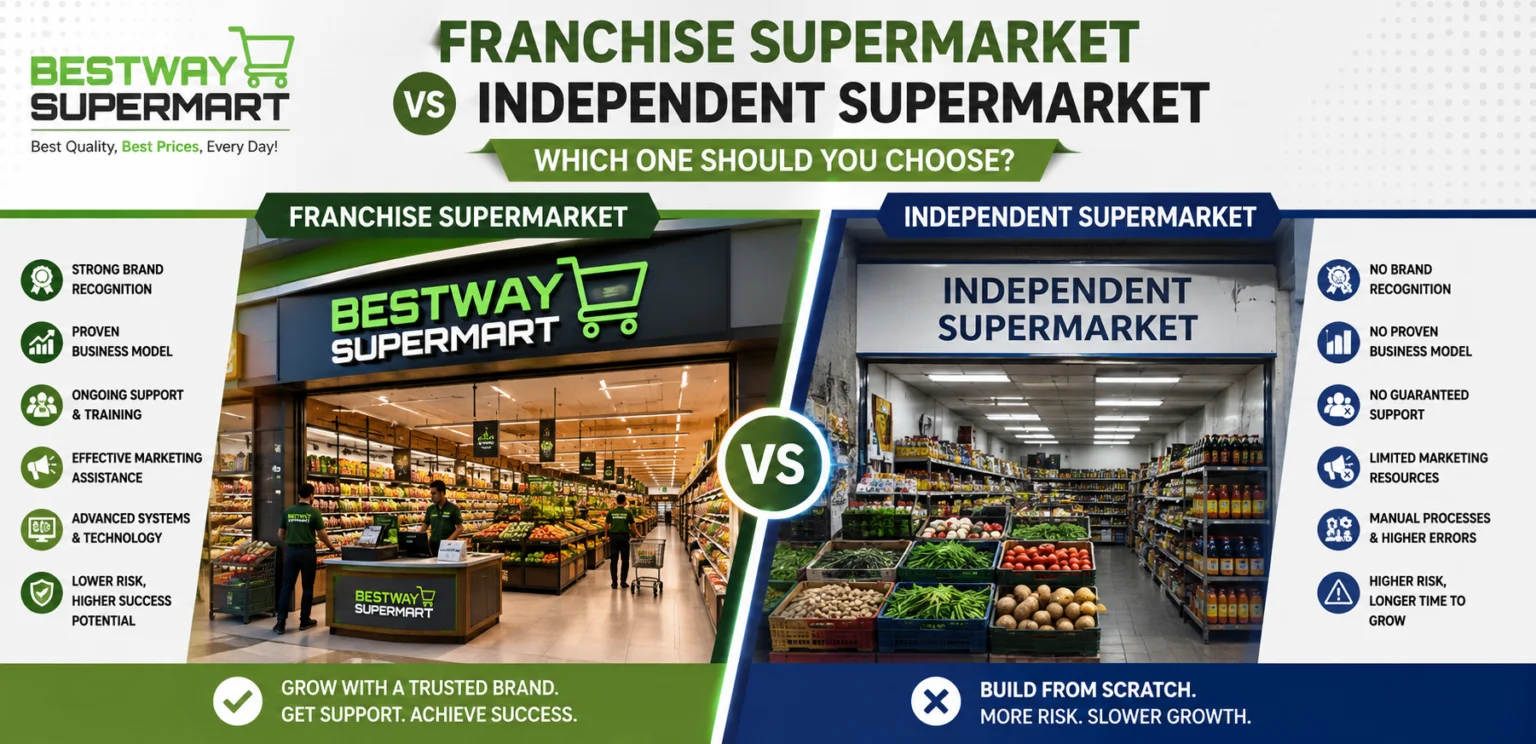
Opening a supermarket appears to be a relatively straightforward exercise. You secure a rental, stock merchandise, hire employees, and officially open the store’s doors. In actuality, however, someone who has spent a considerable amount of time in the retail industry can understand that there is much more to it than initially meets the eye. The challenge is to either build the entire system from the ground up or adopt the proven business model of a Supermarket Franchise.
An independent supermarket offers the owner total freedom, but at the same time, they need to create the brand image, establish supplier relationships, set up store operating procedures, determine the marketing strategy, and build a client base from scratch. A Supermarket Franchise, on the other hand, can offer an established blueprint along with professional branding, operational know-how, technological tools, and expert support. Thus, it is no surprise that for many entrepreneurs, particularly those who want to get involved in organized retail, a supermarket franchise can be a great option to consider.
Franchise Supermarket vs Independent Supermarket: Understanding the Difference
Before making a choice, it is essential to understand the critical differences between the two business models.
When we talk about an independent supermarket, it means that the owner has full control over their business. This person is free to choose any brand name, develop the product catalog, set prices, select suppliers, decorate the store, determine the marketing strategy, and manage employees. At the same time, they have to build the entire system from the ground up and invest significantly in developing the brand image.
A Supermarket Franchise, by contrast, is operated under an existing brand and business model. Thus, the owner only needs to invest in the store and follow the guidelines set by the franchisor.
Independent Supermarket vs Franchise Supermarket: Key Differences
| Store Format | Independent Supermarket | Franchise Supermarket |
|---|---|---|
| Ownership | Controlled by entrepreneur | Controlled under franchisor model |
| Brand | Created by entrepreneur | Provided by franchisor |
| Product Catalog | Determined by entrepreneur | Determined by franchisor |
| Pricing Policies | Set by entrepreneur | Set by franchisor |
| Suppliers | Selected by entrepreneur | Selected by franchisor |
| Store Design | Developed by entrepreneur | Determined by franchisor |
| Operations | Managed by entrepreneur | Supported through franchisor model |
| Marketing Strategy | Developed by entrepreneur | Provided/supported by franchisor |
| Technology | Selected by entrepreneur | Supported through franchise system |
| Customer Experience | Curated by entrepreneur | Guided by franchisor standards |
The most apparent difference between an independent supermarket and a Supermarket Franchise is right in the name – independent means that the entrepreneur can do whatever they want. By selecting the franchise option, however, the owner agrees to operate under the auspices of the franchisor.
Therefore, choosing between the two options ultimately depends on the experience and preferences of the entrepreneur, their budget, and their willingness to make all the hard decisions themselves.
Franchise Supermarket: Why the Model Can Be More Advantageous
There is no doubt that opening a franchise supermarket is much easier than building an independent retail concept from scratch. Here are the most substantial benefits of opting for the franchise business model.
Established Brand Image
Creating a recognizable brand in the retail sector is one of the most challenging tasks that an entrepreneur can face. It takes time and effort to familiarize the public with the brand, engage the audience, build trust and loyalty, and ultimately get the business to a profitable level.
A Supermarket Franchise, by contrast, comes with professional branding and end-to-end support from day one.
Structured Business Model
Operating an independent store often implies having to make all the hard decisions alone. An entrepreneur has to determine the product catalog, secure suppliers, implement the most efficient store operations, set up the billing system, and much more.
When it comes to franchise options, however, everything is much more straightforward as they involve a proven business model that is already established.
Better Operational Support
Running any kind of retail business is all about making the right choices daily. What products to buy? How much inventory to keep? What categories to feature more prominently? How to offer a discount without damaging the profit margins?
With the right Supermarket Franchise, the entrepreneur does not have to rely solely on their own judgment.
Professional Store Layout
Most customers today want to see a particular store format when visiting a supermarket. They enjoy a well-organized shopping experience and seamless navigation through the store aisles and product categories.
An independent retailer has to develop the concept themselves, while a Supermarket Franchise comes with professional store design and brand guidelines.
Access to Technology and Inventory Management
Modern store management would be incomplete without access to the latest technology, analytics, and inventory management tools.
A successful independent supermarket requires the owner to have extensive knowledge and a comprehensive understanding of the retail industry. With the Supermarket Franchise, however, the entrepreneur can rely on the experience and know-how of the franchisor team and the already existing technological infrastructure.
Franchise Supermarket vs Independent Supermarket: Investment and Risk
It is always essential to review the financial side of the transaction before making a choice between an independent supermarket and a Supermarket Franchise.
The initial investment is definitely important, but it is also crucial to remember that the lowest launch cost does not necessarily mean the best value for money.
It is common for independent superstores to have a seemingly lower launch cost due to the absence of a franchise fee. However, the entrepreneur will have to invest in other areas such as operational expertise, technology, supplier relations, brand development, and more.
When choosing the Supermarket Franchise model, the entrepreneur may have to pay more on the surface, but they can receive greater value in terms of overall know-how and guidance.
Supermarket Franchise vs Independent Supermarket: Comparison of Expenses
| Expense | Independent Supermarket | Supermarket Franchise |
|---|---|---|
| Store Rent | Same | Same |
| Security Deposit | Same | Same |
| Interior | Same | Same |
| Inventory | Same | Same |
| Billing | Same | Same |
| Staff Recruitment | Same | Same |
| Branding | Same | Same |
| Marketing | Same | Same |
| Licenses | Same | Same |
| Working Capital | Same | Same |
| Franchise Fee | Not applicable | Varies |
Therefore, when reviewing the expense, it is important to take a closer look at all the details before determining which option is the most viable.
Franchise Supermarket: Marketing Advantages
When it comes to marketing, independent supermarketers have to build the entire concept from scratch.
The entrepreneur has to develop the marketing strategy, come up with unique visuals, determine the target audience, get involved in social media marketing, run local advertisements, and so on.
A Supermarket Franchise, on the other hand, offers end-to-end support and guidance in this regard.
Thus, choosing a Supermarket Franchise can be highly beneficial for the entrepreneur who is unsure of their capabilities in local marketing and has little to no relevant experience.
In addition, it is essential to recognize the value of a professional brand image and its impact on attracting regular customers to the store. Choosing the right local marketing strategy and following the guidance from the franchisor can support business growth in the early months and years following the launch.
Supermarket Franchise: Better Option for First-Time Entrepreneurs
Let us imagine a scenario where two entrepreneurs want to open supermarkets in similar residential areas.
The first one, Entrepreneur A, has decided to go the independent route. Therefore, they have to figure out a way to find the right suppliers and secure competitive pricing. This person will have to determine the product offerings, brand positioning, store layout, billing system, and much more.
Now, let us take a look at Entrepreneur B, who has decided to go for the Supermarket Franchise option. This individual will have to work on the same tasks as Entrepreneur A but will have a reliable guide to lean on.
This does not mean that Entrepreneur B will be able to accomplish every task effortlessly, but the Supermarket Franchise can reduce their burden considerably.
Supermarket Franchise vs Independent Supermarket: Growth Prospects
An independent supermarket certainly has the potential to become a recognizable brand name that can serve as a solid foundation for launching other retail concepts. However, such an undertaking will require a lot of effort and resources.
The independent store owner will have to invest heavily into developing the brand image while building the client base one person at a time.
In the case of a Supermarket Franchise, by contrast, the entrepreneur can take advantage of an established business model. Thus, once the owner learns the ropes of the business, they can potentially replicate their success and launch additional stores following the same business framework, subject to the franchise terms.
Supermarket Franchise: When to Opt for Independent Supermarket
An independent supermarket option is suitable for those entrepreneurs who want total control over their brand and are willing to dedicate all the time and effort necessary for the venture to succeed.
Thus, independent supermarketers usually do not follow a set format and tend to operate outside the traditional retail store concept.
Such a business model is suitable for entrepreneurs with extensive retail experience who know exactly what they are doing.
An independent supermarket owner has the flexibility to make all the important decisions themselves, including setting prices, choosing the product catalog and suppliers, designing the store, implementing the marketing strategy, and much more.
Independent Supermarket: When to Consider It
A first-time entrepreneur will not feel as confident choosing the independent route. Such an initiative will also be much more challenging if the individual has no experience in retail and does not know how to build a successful business concept from the ground up.
In cases like these, a Supermarket Franchise can be a more structured option that reduces some of the challenges entrepreneurs typically face.
The choice between an independent supermarket and a Supermarket Franchise ultimately depends on the entrepreneur’s preferences and their level of expertise.
How to Choose Between a Supermarket Franchise and an Independent Supermarket
Here is a list of five critical questions to ask yourself before determining which supermarket business model you will choose:
| Question | Independent Supermarket | Franchise Supermarket |
|---|---|---|
| Do you have enough experience? | Maybe | Not necessarily |
| Are you open to making all the difficult decisions? | Yes | No |
| Do you want total control? | Yes | No |
| Do you have enough capital to invest? | Possibly | Maybe not |
| Do you want to build one store or multiple? | One | Many |
Thus, if you are someone who wants full control and has the know-how and necessary resources, you can consider launching an independent supermarket.
If you want to reduce the burden of building every business system from scratch, you should think about a Supermarket Franchise.
Final Thoughts: Franchise Supermarket vs Independent Supermarket
Choosing between an independent supermarket and a Franchise Supermarket is ultimately a decision about control versus structured support.
An independent supermarket gives the entrepreneur complete freedom, but the owner must build the brand, supplier network, technology, marketing strategy, store systems and customer base independently.
A Supermarket Franchise, on the other hand, can provide an established business framework, professional branding, operational guidance, technology support and marketing assistance. For first-time entrepreneurs and those who want to reduce the complexity of building a supermarket from scratch, this model can be a particularly attractive option.
If you are planning to enter the organised retail sector, Bestway Supermart is an opportunity worth exploring. Evaluate the available franchise model, investment requirements, store requirements and support structure before taking your final decision.
Ready to explore a Franchise Supermarket opportunity? Connect with Bestway Supermart and take the first step toward building your organised retail business.
FAQs About Franchise Supermarket
1. Is a Franchise Supermarket better than an independent supermarket?
A Supermarket Franchise is a great option for the first-time entrepreneur due to the brand reputation, operational support, technology infrastructure, marketing tools, and professional guidance. However, the choice ultimately depends on individual circumstances, goals, and experience.
2. What is the biggest advantage of a Supermarket Franchise?
The primary advantage of a Supermarket Franchise is that instead of learning everything from scratch, the entrepreneur can rely on the existing know-how, branding, and operational procedures used by their franchisor.
3. Is an independent supermarket cheaper than a franchise?
An independent store has the potential to be cheaper than a Supermarket Franchise, but it depends on the overall scope and details of the initiative.
4. Can a first-time entrepreneur start a Franchise Supermarket?
Yes, a Supermarket Franchise can be an excellent option for first-time entrepreneurs, especially if the franchisor offers sufficient support and guidance.
5. Does a Supermarket Franchise guarantee profit?
No business format is 100% profitable, and a Supermarket Franchise is no exception. The location, clientele, inventory, pricing policy, operating costs, and management will determine whether the initiative is successful.
6. Why should entrepreneurs consider Bestway Supermart?
Bestway Supermart is an organized retail chain that offers a supermarket franchise concept. Therefore, when considering the two superstore formats, entrepreneurs should review this option and pay close attention to the requirements, investment and support provided.